Train Ghost Stories – After the Last Train
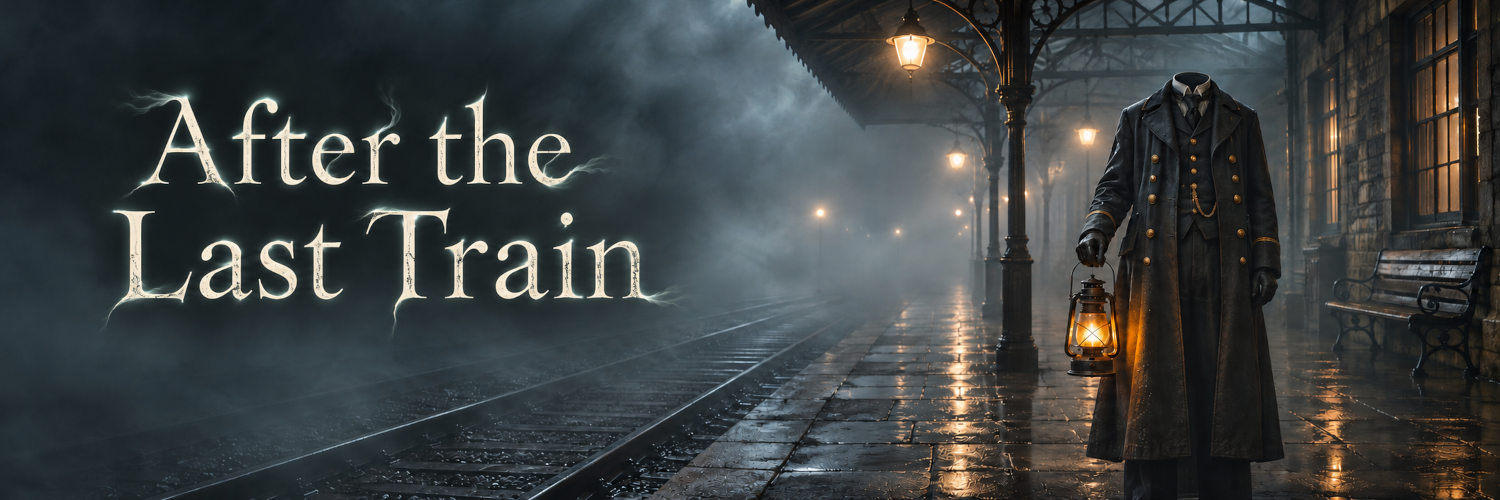
After the Last Train – 10 Ghost Stories from Britain’s Railway Stations and Tunnels
An empty waiting room. Footsteps inside a deserted tunnel. A figure on the line who disappears before anyone can reach them. Britain’s railways have accumulated ghost stories almost as readily as they have carried passengers.
The following short accounts are written afresh from published reports and railway folklore. They describe experiences people have claimed, rather than proven supernatural events. Some come from railway organisations; others survive through second-hand accounts, with no named witness or contemporary record available.
The Guard Who Never Finished His Shift
Bury Bolton Street Station, Greater Manchester
The unsettling thing about the figure in the waiting room was how ordinary he seemed.
According to a report published by the East Lancashire Railway in 2021, a member of staff cleaning the station at night glimpsed someone in overalls sitting on a bench. The man appeared to be asleep.
The railway connected the encounter with “Billy the Guard”, a figure it said passengers had reported seeing over many years. Its commercial manager described the cleaner as sufficiently frightened to avoid platforms three and four afterwards.
A sleeping railwayman ought to be a reassuring sight: someone else still on duty, someone familiar with the building. Here, that familiarity became the frightening part.
The Actor Beneath Covent Garden
Covent Garden Underground Station, London
A tall man in a grey suit and white gloves stands on a platform late at night. In the accounts associated with Covent Garden, he belongs to a different age.
The apparition has been identified in railway folklore as William Terriss, the actor murdered outside the nearby Adelphi Theatre in December 1897. Published collections describe sightings around midnight, particularly during winter.
There is an odd detail beneath the familiar tale: Covent Garden station opened in 1907, a decade after his death. If the figure were Terriss, he would be walking through a station he never knew in life.
Transport for London’s own station artwork page acknowledges the haunting tradition. It does not establish the identity of anything witnesses may have seen.
The Dog You Can Hear but Cannot See
Moulsecoomb Station, East Sussex
A growl from the shadows gives a waiting passenger something immediate to worry about. Where is the dog, and how close is it?
At Moulsecoomb, railway accounts describe people hearing heavy panting and aggressive growling, then finding no animal when they look. Some reports go further, describing the shadow of a large dog moving around the station.
The Southern E-Group’s station history records the tradition, including claims that frightened passengers have fled from the sounds.
One explanation offered in the folklore is that a dog killed on the railway still patrols the platforms. That origin remains speculation. The enduring core of the story is simpler: the sound of an animal nearby, followed by the discovery that there is nothing to see.
Voices Behind the Gothic Towers
Clayton Tunnel, West Sussex
Clayton Tunnel’s northern entrance looks suited to a ghost story before anyone tells one. Gothic towers flank the railway, with a cottage built between them.
Behind that striking façade lies the site of a real catastrophe. In August 1861, a collision inside the tunnel killed 23 passengers.
Accounts attached to the tunnel describe footsteps, tapping, sighs and cries. A white female apparition also appears in the local haunting tradition, which includes experiences attributed to people who have lived at Tunnel Cottage.
An echo inside a railway tunnel can make a sound seem strangely displaced. Yet the possibility of an ordinary explanation has never quite silenced the stories.
At Clayton, the darkness has both a documented history and a voice people have struggled to explain.
The Soldiers in the Tunnel
Balcombe Tunnel, West Sussex
The figures in the Balcombe story are recognisably soldiers. There are three of them in some versions and four in others.
According to reports collected by the Paranormal Database, they appear inside the railway tunnel and gradually fade when approached.
The explanation traditionally attached to them is that First World War soldiers took shelter there during a storm and were struck by a train. The collected account does not establish that explanation through a named casualty record.
That uncertainty leaves the story suspended between railway legend and reported encounter. Its most disturbing image survives either way: a group of men who seem solid at a distance, losing their substance as someone draws nearer.
The Man the Train Could Not Find
Bincombe Tunnel, Dorset
For a driver, a person on the track is an emergency long before it becomes a mystery.
The haunting account associated with Bincombe describes a dark figure in the tunnel and a driver convinced, in 1991, that the train had struck someone. Yet nothing was found.
Later retellings connect the figure with Sidney Watts, a signalman killed in the tunnel in 1883 while walking home after a night shift.
The distinction matters. Watts’s death is documented; identifying the reported apparition as Watts is an assumption. A source review by Wyrdways could not trace a named driver or railway record for the 1991 encounter.
What remains is an unnerving second-hand story: the certainty of seeing a person, followed by an absence where that person should have been.
The Engine Without a Body
Box Tunnel, Wiltshire
Some railway ghosts arrive as sound.
At Box Tunnel, published haunting collections record the noise of a phantom locomotive echoing along the tracks. The surviving summary offers no named witness or firm date, leaving a brief but evocative report.
Its power lies in what a railway sound makes us expect. An approaching engine should eventually become visible. Noise should acquire a shape.
In this account, the sound is the whole encounter.
Tunnels carry, amplify and distort ordinary railway noise, so a ghost engine is far from the only possible explanation. Nevertheless, the idea persists: somewhere in the darkness, an old locomotive can apparently be heard making a journey that nobody sees.
The Actress Who Lost Her Theatre
Aldwych Underground Station, London
Before there was a station, there was a theatre.
Aldwych was built on the site of the Royal Strand Theatre, and a haunting tradition links the railway with a woman said to have belonged to the earlier building.
Published accounts describe a female figure standing on the tracks, reportedly seen by cleaning staff working at night. The suggested identity of an actress is part of the folklore, rather than an established fact.
It is a particularly fitting London ghost story. A building disappears, its purpose changes, and the city continues above it. Beneath the street, the tale suggests, someone has failed to notice.
The theatre has gone. Its supposed performer is still waiting in the wings.
The Passage That Feels Occupied
Page’s Walk, Embankment Underground Station, London
Not every haunting offers a figure to describe.
At Embankment, reports collected about a passage called Page’s Walk concern cold draughts, doors opening and slamming, and an oppressive sense of presence. The database dates the reported complaints to around 2000.
Each detail could have an everyday cause. Underground railways move air through confined spaces, and doors do not need a supernatural hand to close suddenly.
But the experience of being alone is not always governed by what a person can explain afterwards.
The Page’s Walk story rests on that uncomfortable gap: an apparently empty passage that railway staff have reportedly found difficult to experience as empty.
The Grey Lady at Shields Road
Shields Road Subway Station, Glasgow
A woman associated with a fatal railway accident is said to linger at Shields Road.
The haunting collection maintained by the Paranormal Database records a Grey Lady tradition at the station. In the story attached to her, she was killed by an arriving train and subsequently seen again.
The available entry supplies neither a named witness nor a date for an encounter, so the account belongs firmly among collected haunting traditions rather than independently verified incidents.
Even in that spare form, it has an unsettling quality. A station is somewhere people wait briefly before leaving. The Grey Lady’s story imagines the opposite: a passenger bound to the same place, with no departure that will finally take her away.